Definition from the RESNET HERS website: “The Home Energy Rating System (HERS) Index is the industry standard by which a home’s energy efficiency is measured. It’s also the nationally recognized system for inspecting and calculating a home’s energy performance.”
Note: The lower the HERS Rating, the more energy-efficient the building
Average HERS Rating of a Typical House (for 2018 energy code): 100
Average HERS Rating of an Energy Star Certified Home: 80
Average HERS Rating of a Buildgreen Industries Home without Solar Panels: 45
HERS Rating of the Case Study Home (which includes solar panels): 18
Therefore, since the case study house has a HERS rating of 18 and a typical house has a HERS rating of 100, the case study house uses 82% less electricity than a typical house at high load times.
High Load Times: Times of the year when a house requires more heating and cooling capacity. For example, in Myrtle Beach, spring and fall temperatures are quite nice (or don’t add to the load) and so the house doesn’t require much energy to feel pleasant. But summer and winter temperatures that add more load to heat or cool require more energy.
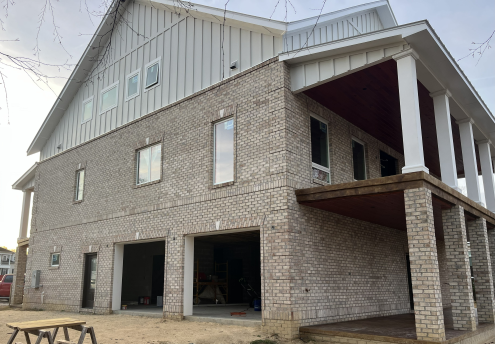
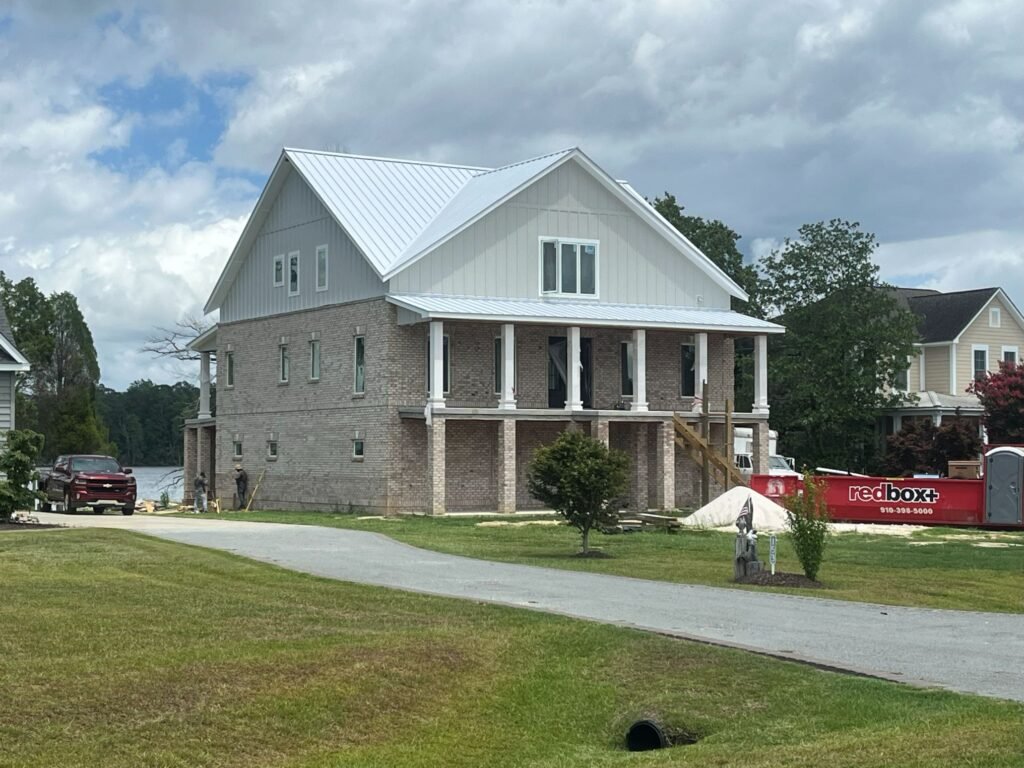
Type of Building: Residential house
Year Completed: 2016
Location: Myrtle Beach, SC
Floors: 2
Interior Details: 4 bedrooms, 2.5 bathrooms, living room, kitchen, and elevator
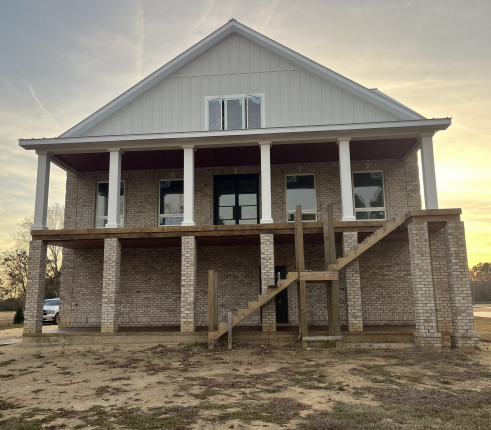
Exterior Details: 4 porches (two upper, two lower) and a garage
Space Under the Roof (including the porches and garage): 5,250 square feet
Conditioned space: 3,400 square feet
Budget for the project: $800,000
Approximate Monthly Energy Bill for a Typical Building of This Size: $368
Average Monthly Energy Bill for the Case Study Home: $70 (for the last 7 years)
Approximate Monthly Energy Savings: $298
Note: $20 of the $70 bill is due to a monthly fee charged by the utility company for installing a special meter at South Carolina houses that use solar
Approximate Monthly Hot Water Bill for a Typical Building of This Size (with a small number of people living there): $50
Approximate Monthly Hot Water Bill for the Case Study Home: $3
Award Won: Santee Cooper Smart Energy New Homes 2016 Program Award Winner, Most Energy Efficient Project
Comfort features: Radiant floor heating system in master bedroom and master bath
Energy-efficient features: Insulated Concrete Forms (ICF), Metal roof, Spray foam insulation, Low-E glass windows, Energy Recovery Ventilator (ERV), Radiant barrier, Composite deck raised concrete floor system, Photovoltaic system, Ground source heat pump system (geothermal), LED lights
Description: Construction company based in Myrtle Beach, SC that builds energy-efficient structures that are cost-effective and durable. Buildgreen Industries is a custom home builder, which means we design/build to your specifications.
In Business Since: 2011
Tom Baker Has Built Energy-Efficient Buildings Since: 2001
Goals as a Business: Seek out the very best technology in order to create buildings that use the least amount of energy for heating and cooling
Area Served: North and South Carolina
Buildgreen Industries is dedicated to being an energy-efficient house builder. There is a process to create an energy-efficient home—creating a sealed envelope, choosing materials that are appropriate to an energy-efficient house, and having a mechanical system that takes advantage of the house’s features.
Buildgreen Industries builds houses so that the outside stays out and the inside stays in. For example, in the summer, in the case study house, the heat of the outside has limited effect on the inside temperature and the cool of the air conditioning doesn’t leave the house much. Therefore, this house requires less air conditioning in the summer.
Another benefit is that houses with sealed envelopes have better air quality than a typical house (because there is less dust).
Energy-efficiency is built into every part of this house and we will discuss each feature in rough order of energy-efficiency.
While we would use the same energy-efficient features in any climate, we adapt the specific techniques we use to implement those features to the hot and humid climate of the Carolinas. We build to the climate zone we’re in.
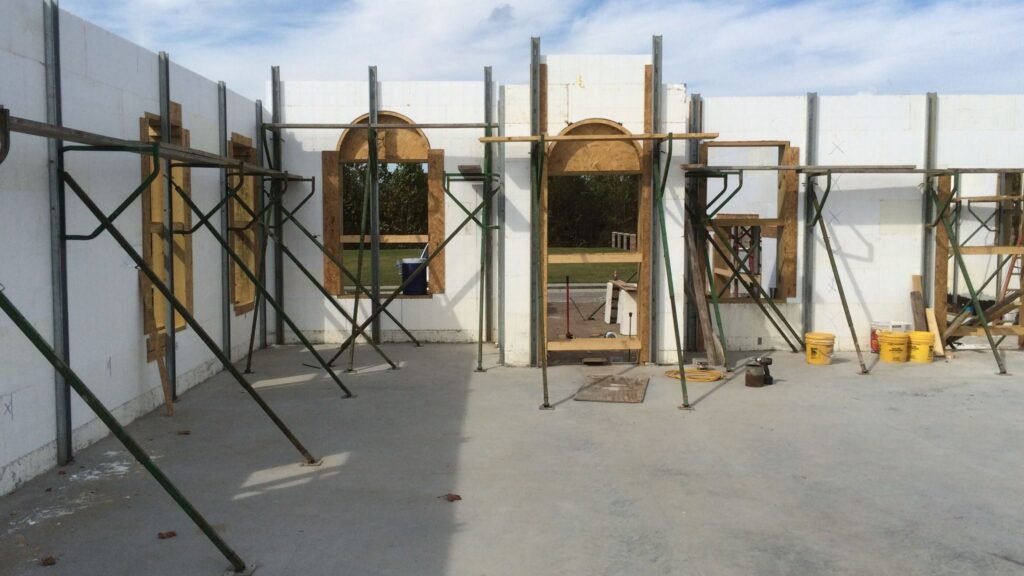
Buildgreen Industries uses a type of wall called Insulated Concrete Forms (ICF). To make these walls, we pour concrete into a Styrofoam mold. This makes each wall of the house a sandwich.
2 inches of Styrofoam – 6-8 inches of concrete – 2 inches of Styrofoam.
Energy-Efficiency: Buildgreen Industries focuses on being green builders. Our concrete solutions are designed to withstand South Carolina’s weather, providing durability against rain, heat, and wear for years to come. Because durable materials need to be replaced less often, durable materials create more sustainable homes. Additionally, ICF helps to create the sealed envelope we mentioned above and therefore causes the house to require less energy to heat and cool.
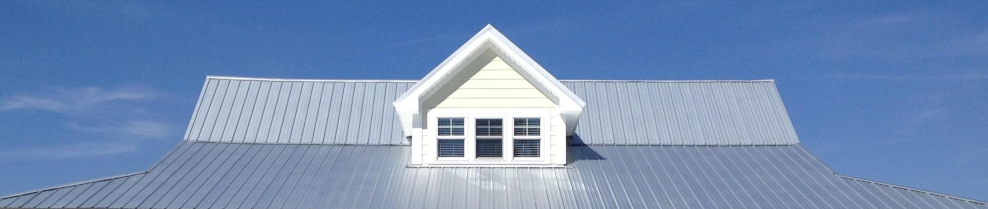
The most common type of roof has asphalt shingles. This house instead has a long-lasting metal roof, specifically a Multi-Rib mechanically fastened metal roof.
Energy-Efficiency: Buildgreen Industries uses metal roofs because they are highly fire-resistant, durable, and reflect UV radiation from sunlight.
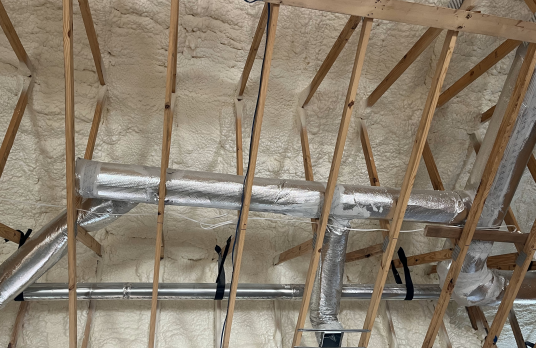
Typically, insulation is made of a fluffy pink material. Because Buildgreen Industries wants to reduce air infiltration, we need a different type that is more energy-efficient. We went with spray foam.
We spray it out as a thin foam and it quickly expands into a thick off-white foam that fills every nook and cranny. We use spray foam to envelope the attic and seal the space—working toward our goal of a sealed envelope. The ICF walls, metal roof, and spray foam insulation are all important elements of creating a sealed envelope.
Energy-efficiency: Due to the spray foam insulation, air cannot leak in or out and this makes sure that the temperature differential between the inside space and the outside air will not impact the inside temperature as much. This promotes sustainability by reducing the amount of energy the heating and cooling system requires to keep the house at an optimal temperature.
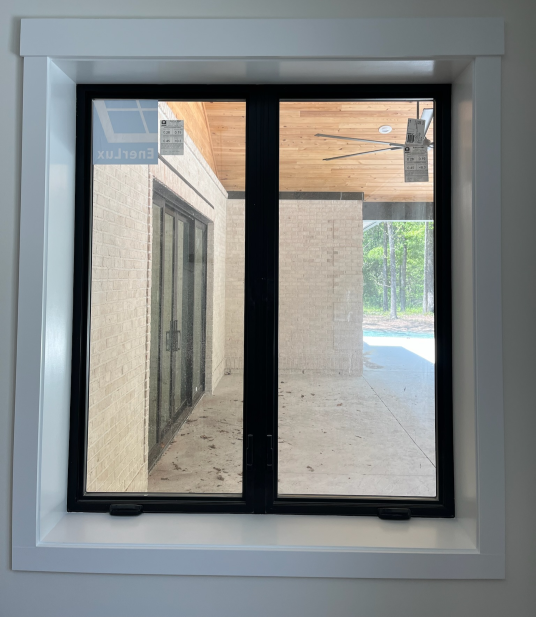
The windows of the case study house don’t look any different from the windows on any other house. But in fact, these windows have a coating on them so thin that it can’t be seen.
Energy-efficiency: These windows slow down the energy transfer through the glass. Therefore, heat leaves the house slower in winter and enters the house slower in summer.
In a typical house, interior air is being exchanged with outside air—this is air infiltration. If you make a very tight house structurally, you create an energy-efficient sealed envelope and there will be less outside air entering the structure. In an eco-friendly home like this one, we install an Energy Recovery Ventilator (ERV) that exhausts air and brings in makeup air through a membrane.
Energy-efficiency: The key idea here is energy transfer. The ERV controls where the new air comes from; it pushes out inside air and pulls in outside air across a single membrane to exchange the energy from the outgoing air with the incoming air. The makeup air is being tempered by the stale outgoing air and this saves energy. In short, the ERV tempers the air that’s coming in with the air that’s going out.
For example, in the winter, you expel warm air from your house using the ERV and pull in cold air from outside. This is a type of energy exchange. The air from the house makes the incoming winter air warmer than it would have been. This way, you won’t have to use as much heat to get the air inside the house to a comfortable temperature.
In short, an ERV unit is eco-friendly because it will help you use less energy to heat and cool your house.
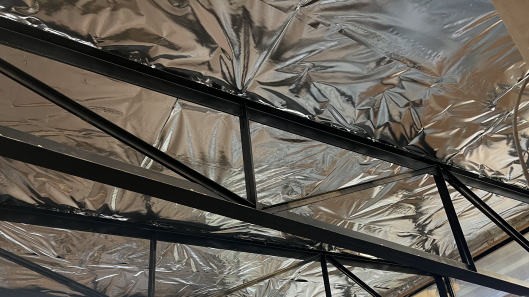
Our next energy-efficient feature can’t be seen in the finished house. This reflective material is installed behind drywall and is especially important in the ceiling. So, radiant barrier does its job while out of sight.
Energy-efficiency: Because radiant barrier is reflective, it lessens the transfer of infrared energy (heat) from the outside to the inside in the summer. In the winter, radiant barrier lessens the amount of energy escaping from the inside envelope to the outside.
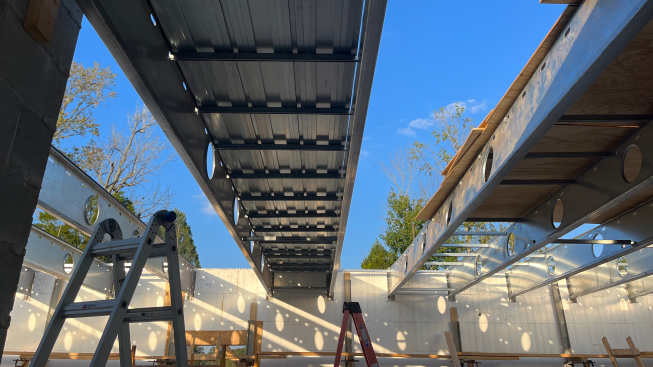
In typical houses, the second level (raised) floor is made of wood trusses, LVL (Laminated Veneer Lumber), and plywood. In this house, the raised floors are made by using metal trusses, metal decking, and poured concrete floor.
Energy-efficiency: The raised metal-and-concrete deck of the second floor of this house does two things. It acts as a concrete diaphragm to make the house very stiff and strong and it is a non-combustible floor compared to a wood truss system.
An additional bonus is that this raised concrete floor acts as a thermal mass to stabilize the temperature of the structure. In a typical house, the second floor is made of wood—it does not help regulate house temperature and is not fire-resistant. Because the second floor of the case study house is made of concrete, this mass becomes the average temperature of the structure. Typically, the thermal mass becomes 72 degrees. Since the second floor is a thermal mass, it can absorb energy if it’s hot outside and radiate energy to the structure if its cold outside. More importantly, the thermal mass stabilizes the temperature of the structure when there’s a load outside—either hot or cold. This means that the structure’s temperature stays more stable (72 degrees) without using as much mechanical (heating or cooling) energy to keep you comfortable.
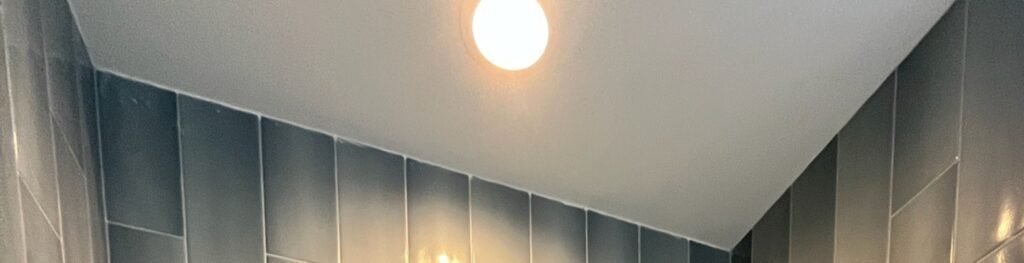
Finally, all of the lights in the house are LEDs.
Energy-efficiency: LED lights use 20% of the energy for the same amount of lumens (light), compared to incandescent bulbs.
The goal of features 1 through 8 was to create a sealed envelope that reduces the need for fossil fuels to heat and cool the house. For features 9 and 10—photovoltaic system and ground source heat pump system—the goal is to use sunlight and ground source heat and so use fewer fossil fuels for the mechanical needs of this home.
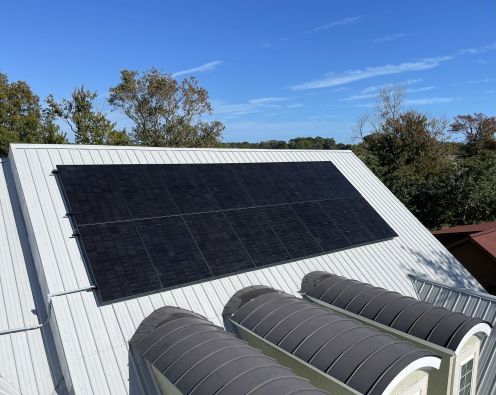
From the ground, solar panels look like blueish panels sitting on the roofs of houses. Our case study house uses a 7.5 kW pv photovoltaic system for part of its electricity.
Energy-efficiency: A photovoltaic system converts sunlight into electricity, which is especially useful in a sunny state like South Carolina and is part of our goal of matching our energy-efficiency techniques to the area. Because the case study house is already energy-efficient, a smaller photovoltaic system will cover a larger percentage of the energy needs of the house than in a typically-constructed house.
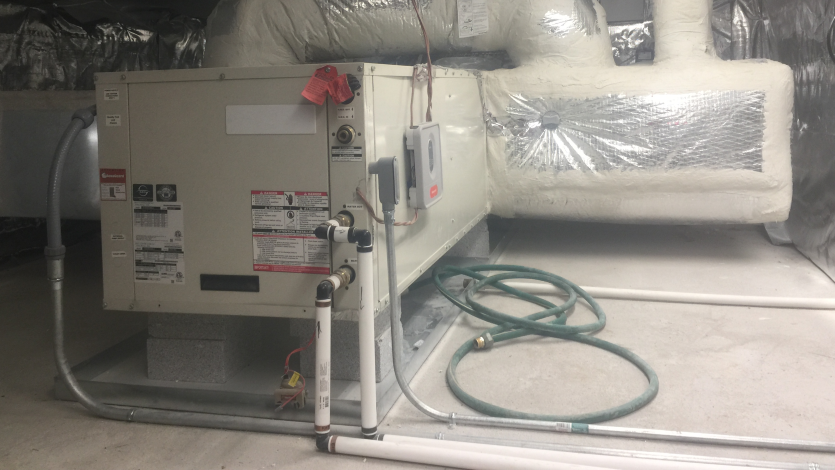
Like the solar panels, this is another way to reduce the amount of electricity needed from the grid. And like radiant barrier, it’s hidden. If a person was walking near the case study house and could see through the ground, they would see a series of polyvinyl piping in the dirt—this ground loop is the “ground source” part of the name.
Energy-efficiency: First, heat pump technology is all about energy transfer from one place to another. It is more efficient to transfer energy than it is to consume or generate it. In a typical home, an air-to-air heat pump exchanges the heat from the inside structure to the air outside through the outside compressor. This poses a problem for energy-efficiency. For example, imagine that the heat pump is trying to exchange the heat from inside the house with 100-degree air outside through the outside compressor.
The advantage for a ground source heat pump is that it is much easier to dissipate heat into 67-degree wet dirt (ground source) than 100-degree air. Heat always moves from hot to cold, so heat will leave the house and the ground will absorb some of the BTUs (a measure of heat), sending back newly cooled air.
In addition, in the winter, it is easier to get BTUs out of a ground source system (67-degree wet dirt) than out of 20-degree air. It is the opposite of summer, in that the cold from the house will absorb into the wet dirt and heat will flow back inside. With a ground source, it will be more energy-efficient for a geothermal system to bring warmth (BTUs) into the house.
Using a ground source heat pump is another example of building to the climate zone you’re in. In a hot, arid climate, we would need to use different technology, but in North and South Carolina, the ground is always around 67 degrees, which is an ideal temperature to exchange BTUs with and so ideal for geothermal.
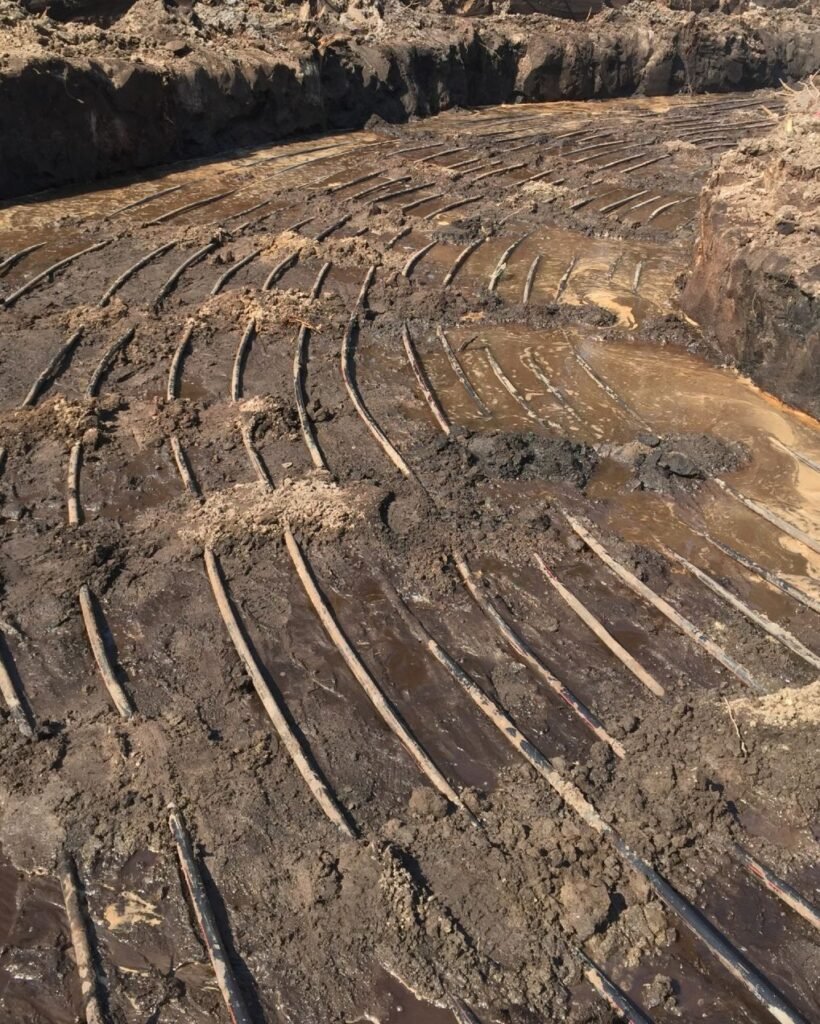
Part of the advantage of a geothermal system is that you can opt for a desuperheater (which is an option for ground source heat pump systems), which takes the heat of the house (BTUS) and puts it into the domestic hot water for consumption, before transferring this same heat to the ground loop to dissipate.
Energy-efficiency: It is more cost-effective to transfer energy that was captured from the house to the domestic hot water, than to heat the water by any other means (generating or consuming). The typical number of BTUs captured from cooling a house in our climate zone (7) is usually more than enough BTUs for all the case study house’s domestic hot water consumption. This technology has been readily available for decades, but has not been utilized because most people are unfamiliar with this possibility.
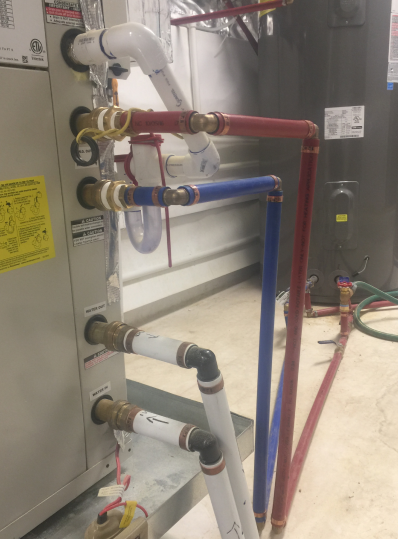
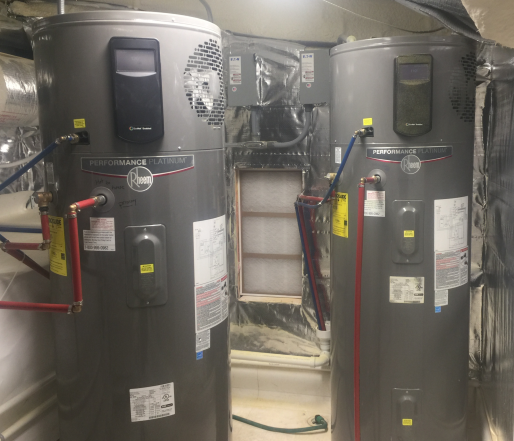
The primary water heater connected to the desuperheater is an 80-gallon Rheem hybrid water heater.
Energy-efficiency: This is a very efficient water heater. In a typical house, one unit of electricity creates .95 of a unit of heat. That is a Coefficient of Performance (COP). In the primary hybrid hot water heater in the case study house, one unit of electricity creates 2.35 units of heat, which gives a COP of 2.35. This system is most effective in the summer.
Often people are not aware of the technological innovations that are available and we want to change that. Buildgreen Industries requires no new technology—we are simply using existing technology and a solid knowledge of basic scientific principles in a highly energy-efficient manner to create eco-friendly structures. We are practical—balancing energy-efficiency with long-term savings.
Buildgreen Industries brought years of green home building expertise to creating the case study house. This large home, and all the other structures we build, require less repair and replacement and use about half as much energy for heating and cooling the house at high-load times as a typical home.
All in all, using a mix of features that both reduce the need for energy and that derive energy from renewable sources, the case study house achieves a high level of energy-efficiency.